
For a foreign company, litigation in Turkey often looks like a chain of trips: Istanbul, Ankara, Izmir, a notary, a translator, a hotel. In practice, a substantial part of commercial hearings can be held remotely. Turkish procedure allows it. The point is not the lawyer’s convenience. The point is that the client should not pay for travel where a video appearance is procedurally sufficient.
Turkish International Law & Consulting Firm (RT Union) conducts cases for EU, CIS and other foreign clients in Turkish courts with a cost-control rule: online participation is the default; personal attendance is used only when it can change the outcome.
Why the court city and the lawyer’s city often differ
A commercial claim is usually filed at the defendant’s domicile. If the debtor is registered in Istanbul (Pendik, Kadıköy, Şişli and similar districts), the case will be heard by the Istanbul Commercial Court of First Instance (İstanbul Asliye Ticaret Mahkemesi). Counsel may be admitted in another bar — Antalya, Ankara or Izmir.
This is a standard arrangement for a foreign client. The law does not require the representative to live in the same city as the court. What is required is proper representation, compliance with deadlines, and appearance at the hearing — in person or in the form the court permits.
What an online hearing means in a Turkish court
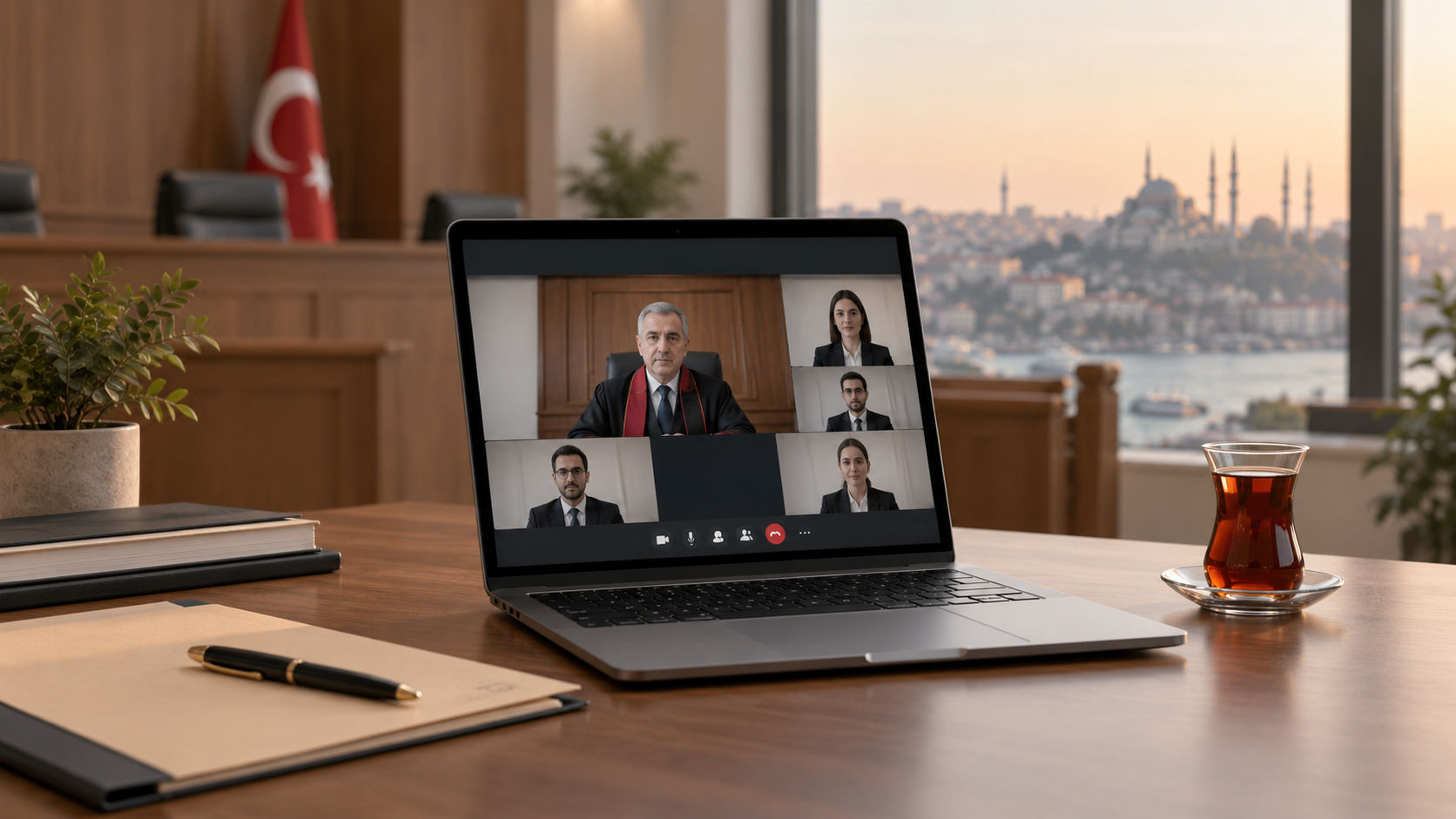
Remote participation is provided through SEGBİS (Ses ve Görüntü Bilişim Sistemi), linked to the national judicial network UYAP. Counsel joins by video. The court records the appearance in the minutes. The parties file motions, make submissions and hear the opposing position.
The online format is widely used in commercial disputes: preliminary hearings, adjournments, amendments of claims, monitoring expert deadlines, and argument on documents already in the file. For the foreign principal this means the case moves forward without travel fees.
When online participation is enough
In most first-instance hearings the court does not need “people in the room”. It needs procedural acts: confirmation of authority, a request for adjournment, filing a sworn translation of the contract, objections to an expert report, agreement on a timetable. Counsel can do all of this remotely without weakening the defence.
Typical situations where online appearance is a reasonable and sufficient standard:
• a preliminary hearing and review of the conditions of the claim;
• a listed hearing at which the court only adjourns the case or orders an expert report;
• exchange of positions on documents already on the court file;
• time-limit control, extension requests and applications on evidence;
• appellate hearings where the court examines written materials.
When personal attendance is still required
The court may refuse online participation or order an in-person appearance. Travel is then a procedural necessity, not a matter of comfort. Attendance in person is usually required if:
• the court has expressly directed personal appearance of counsel;
• a witness, a party or an expert is to be examined and the judge wants to assess testimony directly;
• originals of contracts, seals or wet-ink instruments must be produced;
• an application for interim measures, attachment of accounts or a restraint on assets is being heard, where speed and presence affect the result;
• the opponent appears in person and the court considers live argument necessary.
In those situations travel is justified. In all others it is an unnecessary charge on the dispute budget — especially where the claim is relatively modest.
How we keep the client’s costs down

The rule is simple: the client pays for what advances the case, not for the lawyer’s geography.
The fixed fee for the litigation stage covers drafting and filing the claim, work in UYAP, motions, and participation in hearings online. Separate attendance and travel costs arise only if the court requires appearance or travel becomes necessary for procedural reasons.
In practice RT Union works under four rules:
- Before filing we assess the court, the city and the likelihood of in-person hearings, so the client sees the cost structure in advance — not after the first summons.
- In every case we apply for participation via SEGBİS. Online is the base scenario, not the exception.
- We give notice of any travel in advance. The client approves the trip before it takes place. No notice, no necessity — no travel charge.
- We do not multiply hearings for the sake of being in the room. If the court can decide the point on the papers, there is no reason to fly to another city.
What this means for a foreign business
For a company in the EU, the UK or the CIS, a Turkish case already includes translations, notarial notices, court fees and expert costs. Counsel’s trips to every listing can quickly approach the value of the claim — particularly in disputes of EUR 10,000 to 50,000.
The online model keeps the litigation stage predictable: a clear fixed fee, a clear rate for travel if it is needed, and no hidden trip counter. The client controls the budget. Counsel controls the process.
How RT Union runs the case
We represent foreign principals in commercial, contractual and construction disputes throughout Turkey. The practice is based in Antalya. Cases against debtors in Istanbul, Ankara and other cities are run centrally: documents, demand letter, mediation, claim, hearings.
The client does not need to come to Turkey for every listing. A power of attorney, a document set and prompt communication are enough. Personal appearance of a company director is rarely required; if the court insists on examining a party, that is agreed separately.
Who this model is for
This note is for companies and entrepreneurs recovering a debt from a Turkish counterpart, or disputing a supply, works, real-estate or agency contract, who need to know in advance how a Turkish court budget is built.
Conclusions
An online hearing in a Turkish court is a working procedural tool, not a second-best compromise. In-person attendance is used selectively. The correct strategy is to apply for SEGBİS by default and travel only when it changes the course of the case.
That is how a foreign client keeps the quality of representation and does not pay for unnecessary flights between Antalya and Istanbul.
Contact
Turkish International Law & Consulting Firm / RT Union
Website: https://rt-union.com/en
Tel. Russia: +7 (812) 210-00-77
Tel. Turkey: +90 (552) 647-07-17
Request an estimate of the court budget for your dispute in Turkey: which hearings can be held online and in which cases counsel will need to attend in person.