Recovering Money from a Developer in Turkey | Civil Claim and Parallel Criminal Case 2026

Introduction
European buyers of off-plan apartments in Antalya, Alanya, Istanbul and Mersin often face the same pattern: payments were made, the promised delivery date has passed, the unit is not transferred, and the developer offers new dates or silence.
A civil claim for termination of the contract and repayment of the price is the main instrument for getting the money back. In a defined set of cases it should run together with a criminal complaint. The two tracks serve different purposes and are not interchangeable.
RT Union represents EU clients in both tracks before Turkish courts and the public prosecutor.
When the dispute is only civil

Failure to complete the building on time, defects, or a change of finishing materials is, as a rule, a breach of contract under the Turkish Code of Obligations. The remedy is:
– mandatory mediation in consumer disputes (since 2023);– an action before the consumer court or the civil court of first instance;– termination of the contract and repayment of the purchase price with interest;– an interim injunction (ihtiyati tedbir) to freeze the unit or related assets;– enforcement under the Enforcement and Bankruptcy Law No. 2004.Yargıtay treats a genuine attempt to build that later failed as a civil matter, not as fraud.
When a criminal case is justified
The line is intent and deceit at the moment the money was taken. Under Articles 157 and 158 of the Turkish Penal Code (TCK), fraud requires misleading conduct that causes the victim to part with money for the perpetrator’s benefit.
In developer cases the criminal threshold is typically crossed where:
– the same independent unit was sold to more than one buyer;– construction permits, architectural plans or title documents were forged (TCK Art. 204);– funds of later buyers were used to pay earlier buyers with no real construction on site;– the developer never intended to complete or transfer the unit and concealed that fact;– the sale was made by a person acting in a commercial capacity — aggravated fraud under TCK Art. 158/1-h.Penalties: 1–5 years (Art. 157) or 3–10 years (Art. 158), with higher floors where banks, public bodies or organised activity are used.
A delayed project without deceit is not a crime. Filing a complaint in that situation wastes time and can weaken the civil strategy.
Why the two tracks should run together
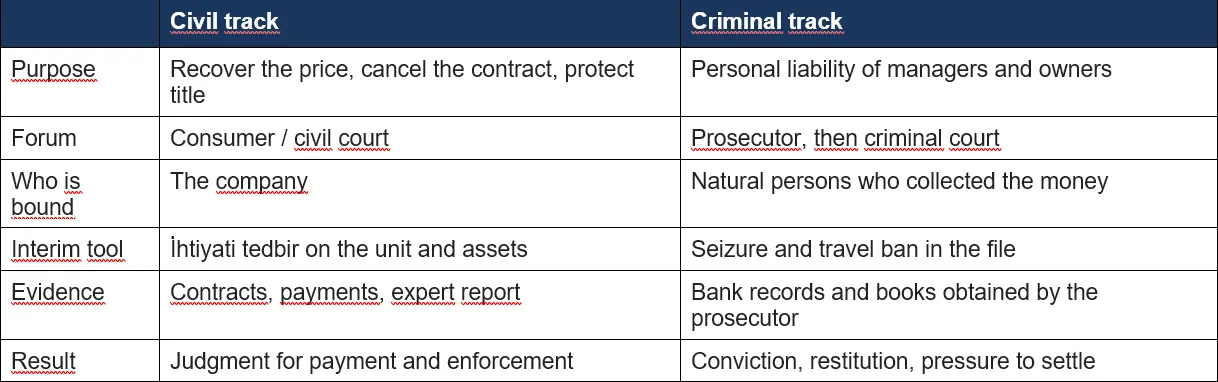
The civil judgment is what the bailiff executes. The criminal file is what prevents the managers from emptying the company and leaving the jurisdiction while the civil case is pending. A conviction is not required before the civil claim is filed. The files proceed in parallel.
Practical sequence for an EU buyer
1. Collect the preliminary contract, payment receipts, brochures, messages and land-registry extract.
2. Serve a formal notice of default and, where the buyer is a consumer, apply for mediation.
3. File the civil claim together with an application for an interim injunction.
4. If the facts meet the deceit threshold, file a criminal complaint and join as intervening victim (katılan).
5. Instruct a court expert on quantum in the civil case; use the same figures in the criminal file.
6. Enforce the civil judgment; use the criminal file to locate assets held in the names of managers.
Benefits for European clients
The European buyer needs two results: the money back, and a barrier against dissipation of assets. A civil claim alone often meets an empty company. A criminal complaint alone does not produce an enforceable payment title.
Running both tracks under one mandate gives a single English-speaking point of contact, filings in Turkish, and a written assessment of whether the facts support fraud or only delay — made before the complaint is lodged.
Request a confidential review of your developer contract and payment file.