Russia Sanctions 2026: Legal Risks for International Companies Doing Business Through Turkey

EU 21st Sanctions Package Against Russia
International companies trading with Russia through Turkey face an increasingly complex sanctions and export-control environment in 2026.
On 23 July 2026, the European Union adopted its 21st package of sanctions against Russia. The measures expanded restrictions affecting financial services, banking, crypto-assets, energy, international trade, dual-use goods, technology and entities associated with Russia's military-industrial sector.
The package also strengthened measures targeting sanctions circumvention through third countries. Entities located in China, Hong Kong, India, Kazakhstan, Kyrgyzstan, Türkiye and the United Arab Emirates were among those subjected to tighter export restrictions. Four entities established in Türkiye were included.
Does Turkey Apply EU Sanctions Against Russia?
Turkey is not an EU Member State and does not automatically incorporate the EU sanctions regime against Russia into Turkish law. However, this does not mean that transactions conducted through Turkey are automatically outside EU, US or UK sanctions exposure.
A transaction involving a Turkish company may still raise sanctions or export-control issues where there is a relevant jurisdictional nexus, restricted goods or technology, designated parties, controlled ownership, international banking infrastructure or other regulated elements. Each transaction therefore requires an individual legal assessment.
Sanctions Risks When Trading With Russia Through Turkey
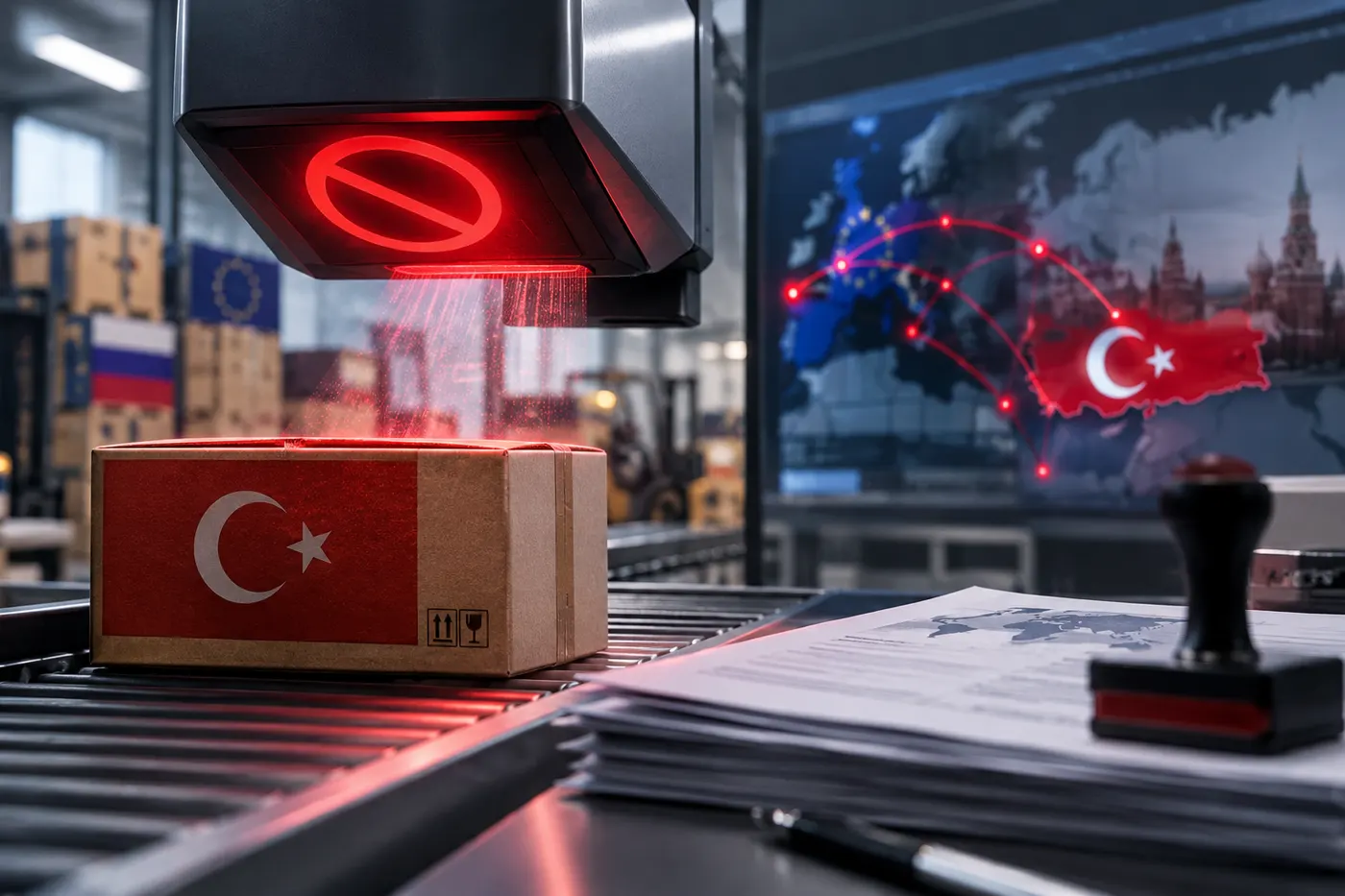
Companies should pay particular attention to EU- or US-origin goods and technology, dual-use items, electronics and microelectronics, industrial machinery and components, sanctioned Russian companies or financial institutions, third-country intermediaries, complex re-export structures, China, Hong Kong, UAE or Central Asian supply chains, maritime transportation and restricted payments.
The use of a Turkish intermediary does not, by itself, remove restrictions applicable to the underlying goods or transaction.
Counterparty Screening and Product Review
Traditional sanctions screening is only the first step. A proper review should identify shareholders, ultimate beneficial owners, controlling persons, affiliated companies, banks, intermediaries, end users and the actual commercial purpose of the transaction.
Companies should also determine the appropriate HS/CN classification, technical characteristics and origin of the product and assess whether the goods are subject to applicable export controls, dual-use restrictions or Russia-specific trade restrictions.
Banking, Payments and International Contracts
A transaction may not necessarily be prohibited under Turkish law while a commercial bank may nevertheless refuse to process it because of internal sanctions policies, correspondent banking relationships or international compliance obligations.
Contracts involving Russia should contain carefully drafted sanctions and export-control provisions, including representations concerning sanctions status, ownership and control, end-user information, product use, compliance obligations and contractual consequences where performance becomes prohibited by applicable law.
A Practical Compliance Model
For cross-border transactions involving Russia, companies should consider the complete transaction chain:
Product → Origin → Seller → Buyer → UBO → End User → Bank → Payment → Logistics → Applicable Restrictions
Turkish International Law & Consulting Firm provides cross-border legal support in sanctions screening, ownership and UBO analysis, Russia-related trade compliance, export-control analysis, international contracts, payment structures, Turkey-Russia commercial transactions and cross-border disputes.
Sanctions compliance should begin before the contract is signed, the payment is made or the goods are shipped.
Chukavin Pavel - Partner & Attorney at Law 2026-09-21 14:26